
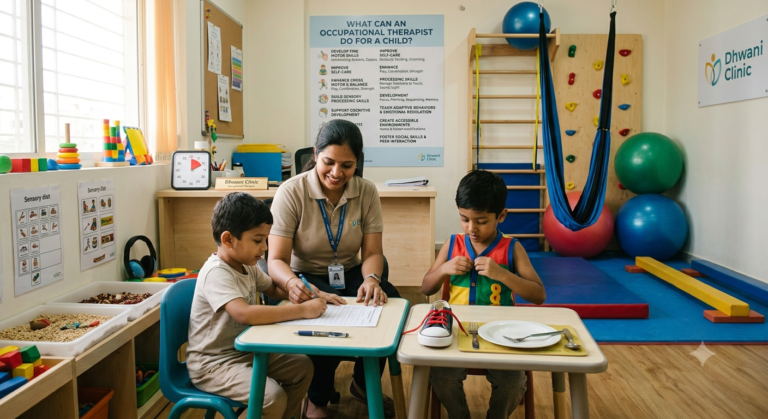
What Can an Occupational Therapist Do for a Child?
Every child develops at their own pace, but sometimes they need extra support to build essential life skills. If your child struggles with everyday activities like writing, dressing, eating, playing, or concentrating in school, an occupational therapist can make a significant difference. At Dhwani Clinic, experienced occupational therapists help children develop the skills they need to become more confident, independent, and successful in daily life.
Occupational therapy is not just about treating a condition—it focuses on improving a child’s ability to participate in meaningful daily activities while supporting their physical, emotional, cognitive, and sensory development.
What Is Occupational Therapy for Children?
Occupational therapy (OT) helps children improve the skills needed to perform everyday tasks independently. These tasks include self-care, school activities, play, social interaction, and fine motor development.
An occupational therapist carefully evaluates a child’s strengths and challenges before creating a personalized treatment plan. The therapy sessions are engaging, fun, and play-based, allowing children to learn naturally while developing important life skills.
At Dhwani Clinic, every therapy plan is tailored according to the child’s age, developmental needs, and individual goals.
Signs Your Child May Need an Occupational Therapist
Many parents wonder whether their child requires occupational therapy. Some common signs include:
Difficulty holding a pencil correctly
Poor handwriting
Trouble using scissors
Difficulty buttoning clothes or tying shoelaces
Delayed developmental milestones
Problems with balance and coordination
Sensitivity to loud sounds, lights, or certain textures
Difficulty focusing in class
Poor social interaction
Challenges with feeding or self-care activities
Weak hand strength
Trouble following instructions
If these challenges interfere with your child’s daily routine, an occupational therapist can help identify the underlying causes and provide appropriate intervention.
How Does an Occupational Therapist Help a Child?
Occupational therapists work on multiple areas of child development. Their goal is to help children become as independent as possible.
1. Improves Fine Motor Skills
Fine motor skills involve small muscle movements of the hands and fingers.
Therapy helps children improve:
Pencil grip
Handwriting
Coloring
Cutting with scissors
Buttoning shirts
Using utensils
Opening containers
These skills are essential for school and daily living.
2. Develops Gross Motor Skills
Gross motor skills involve larger body movements.
Occupational therapy can improve:
Running
Jumping
Climbing stairs
Catching and throwing a ball
Balance
Body coordination
Better gross motor skills allow children to participate more confidently in sports and playground activities.
3. Supports Sensory Processing
Some children are overly sensitive or under-responsive to sensory information such as touch, sound, movement, or textures.
Occupational therapists use sensory integration techniques to help children:
Tolerate different textures
Handle loud noises
Improve attention
Stay calm in busy environments
Regulate emotions
Improve body awareness
Sensory therapy can greatly improve a child’s comfort at home and school.
4. Enhances Self-Care Skills
Occupational therapists teach children how to become more independent in daily routines.
These include:
Dressing
Brushing teeth
Bathing
Eating independently
Toileting
Washing hands
Organizing school bags
As children master these skills, they become more confident and less dependent on parents.
5. Improves Attention and Learning Skills
Many children struggle to sit still, concentrate, or complete classroom tasks.
Occupational therapy helps improve:
Attention span
Memory
Visual perception
Problem-solving
Classroom participation
Task completion
These improvements often lead to better academic performance.
6. Builds Social and Play Skills
Play is one of the most important ways children learn.
Occupational therapists encourage children to develop:
Sharing
Taking turns
Communication
Teamwork
Emotional regulation
Confidence during group activities
Improved social skills help children build stronger friendships.
Conditions Treated by Occupational Therapists
Occupational therapy benefits children with many developmental and neurological conditions, including:
Autism Spectrum Disorder (ASD)
ADHD
Cerebral Palsy
Down Syndrome
Developmental Delay
Learning Disabilities
Sensory Processing Disorder
Intellectual Disabilities
Fine Motor Delay
Coordination Disorders
Premature Birth Developmental Delays
Early intervention often leads to better long-term outcomes.
What Happens During an Occupational Therapy Session?
Many parents worry that therapy sessions will feel like school. In reality, occupational therapy is designed to be enjoyable and motivating.
A typical session may include:
Interactive games
Obstacle courses
Building blocks
Sensory activities
Hand strengthening exercises
Balance training
Puzzle solving
Drawing and coloring
Play-based learning
These activities help children develop important skills while having fun.
Benefits of Early Occupational Therapy
Starting therapy early can significantly improve a child’s development.
Benefits include:
Increased independence
Better school readiness
Improved handwriting
Stronger motor skills
Better concentration
Enhanced confidence
Reduced sensory difficulties
Improved emotional regulation
Better communication through play
Greater participation in daily activities
Early intervention allows children to overcome developmental challenges before they become more difficult to manage.
Why Parents Choose Dhwani Clinic
Choosing the right therapy center is an important decision. At Dhwani Clinic, children receive compassionate, individualized care in a child-friendly environment.
Parents trust Dhwani Clinic because of:
Experienced occupational therapists
Personalized therapy programs
Evidence-based treatment approaches
Child-friendly therapy sessions
Parent guidance and home activity plans
Regular progress monitoring
Holistic developmental support
The clinic focuses on helping every child achieve their fullest potential through structured, engaging, and goal-oriented therapy.
Tips for Parents to Support Therapy at Home
Parents play an essential role in their child’s progress.
Simple activities at home include:
Encourage drawing and coloring.
Let your child help with dressing.
Play with building blocks and puzzles.
Practice cutting paper safely.
Encourage outdoor play.
Read books together.
Create sensory play activities using sand, rice, or clay.
Celebrate small achievements to build confidence.
Consistency between therapy sessions and home practice leads to faster improvement.
Conclusion
Occupational therapy empowers children to overcome developmental challenges and gain the confidence to participate fully in everyday life. Whether your child has difficulties with motor skills, sensory processing, learning, or self-care, early intervention can make a lasting difference.
At Dhwani Clinic, dedicated occupational therapists provide personalized care that supports every child’s unique developmental journey. With the right guidance, therapy, and family involvement, children can build the skills they need to thrive at home, in school, and in their communities.
If you notice your child struggling with everyday activities or developmental milestones, scheduling an occupational therapy assessment at Dhwani Clinic is an important first step toward helping them achieve greater independence and a brighter future.