
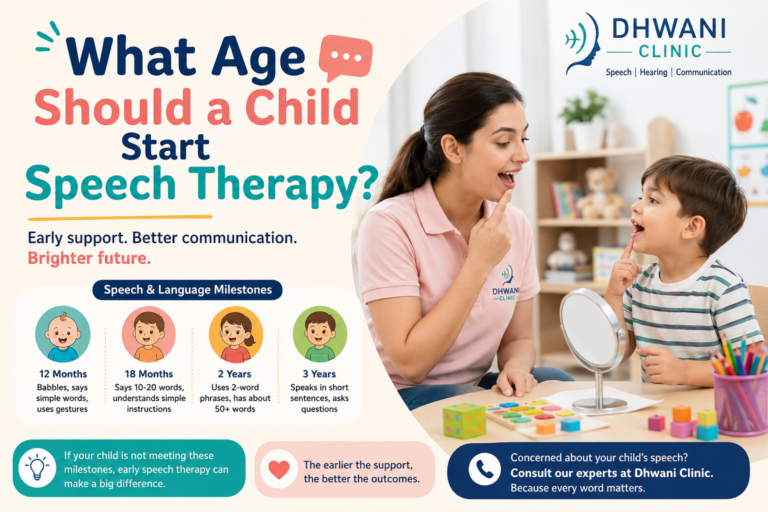
What Age Should a Child Start Speech Therapy?
Every child develops speech and language skills at their own pace. Some children begin talking early, while others take a little longer to communicate. However, when speech or language milestones are significantly delayed, early intervention becomes essential. One of the most common questions parents ask is, “What age should a child start speech therapy?”
The answer is simple: there is no minimum age if a delay is identified. Children can benefit from speech therapy as early as 18 months or even younger, depending on their developmental needs. The earlier a child receives professional support, the better the chances of improving communication, learning, and social skills.
At Dhwani Clinic, experienced speech-language pathologists assess each child’s communication abilities and provide personalized therapy plans that help children reach their full potential.
Why Early Speech Therapy Matters
The first five years of life are the most important for brain development. During this period, children rapidly learn language, speech sounds, listening skills, and social communication. If a speech or language delay is left untreated, it may affect:
Learning and academic performance
Reading and writing skills
Social interaction
Emotional development
Confidence and self-esteem
Early speech therapy takes advantage of the brain’s natural ability to learn and adapt. This means children often make faster and more lasting progress when therapy begins early.
Speech and Language Milestones by Age
Understanding typical developmental milestones can help parents identify whether their child may need professional support.
By 12 Months
A child should:
Respond to their name
Babble with different sounds
Say simple words like “mama” or “dada”
Use gestures such as waving or pointing
By 18 Months
Children generally:
Speak around 10–20 words
Understand simple instructions
Point to familiar objects
Try to imitate words
By 2 Years
Most children:
Use at least 50 words
Combine two words into simple phrases
Follow two-step directions
Be understood about 50% of the time
By 3 Years
A child should:
Speak in short sentences
Ask simple questions
Have a vocabulary of several hundred words
Be understood by familiar adults most of the time
By 4 Years
Children usually:
Speak clearly enough for strangers to understand
Tell simple stories
Use complete sentences
Understand basic concepts such as colors and numbers
If your child is missing several of these milestones, it is a good idea to consult a speech-language pathologist.
Signs Your Child May Need Speech Therapy
Parents should seek professional advice if their child:
Is not babbling by 12 months
Does not say meaningful words by 18 months
Has fewer than 50 words at age 2
Does not combine words into short phrases by age 2
Has unclear speech after age 3
Has difficulty understanding simple instructions
Stutters frequently
Has trouble interacting with others
Loses previously learned speech or language skills
These signs do not always indicate a serious disorder, but they should never be ignored.
What Is the Best Age to Start Speech Therapy?
There is no single “perfect” age because every child is different. However, many speech-language experts recommend beginning therapy as soon as a delay is identified.
Children between 18 months and 3 years often respond exceptionally well because their brains are still rapidly developing. Early therapy helps children build communication skills before they begin school, reducing future learning challenges.
Even older children can benefit significantly from speech therapy. Whether your child is three, five, or even older, professional intervention can improve speech clarity, language understanding, and communication confidence.
Conditions That May Require Early Speech Therapy
Speech therapy can help children with a wide range of communication challenges, including:
Speech delay
Language delay
Autism Spectrum Disorder (ASD)
Developmental delay
Childhood apraxia of speech
Stuttering
Hearing impairment
Articulation disorders
Voice disorders
Feeding and swallowing difficulties
A detailed assessment helps determine the most appropriate treatment plan for each child.
What Happens During Speech Therapy?
Speech therapy sessions are designed to be engaging, interactive, and age-appropriate. Young children learn best through play, so therapists use fun activities that encourage communication naturally.
Therapy may include:
Picture-based learning
Storytelling
Singing and rhymes
Sound production exercises
Vocabulary-building games
Language comprehension activities
Oral-motor exercises (when needed)
Parent coaching and home practice strategies
Every session is tailored to the child’s specific strengths and challenges.
The Importance of Parent Involvement
Parents play a vital role in their child’s progress. A speech therapist provides guidance on activities that can be practiced at home to reinforce learning between therapy sessions.
Helpful strategies include:
Reading books together every day
Talking during everyday routines
Naming objects around the house
Encouraging turn-taking in conversations
Singing nursery rhymes
Limiting excessive screen time
Praising all communication attempts
Consistent practice at home often leads to faster improvement.
Why Choose Dhwani Clinic?
At Dhwani Clinic, children receive compassionate, evidence-based speech therapy in a welcoming and child-friendly environment. Each child undergoes a comprehensive evaluation before therapy begins, ensuring a personalized treatment plan that meets their individual needs.
The clinic offers support for speech delays, language disorders, stuttering, articulation problems, autism-related communication challenges, hearing-related speech issues, and developmental communication disorders. Therapists work closely with parents, helping families become active partners in their child’s communication journey.
With individualized care, modern therapy techniques, and regular progress monitoring, Dhwani Clinic is committed to helping every child communicate with confidence and achieve their developmental milestones.
Conclusion
The best time to start speech therapy is as soon as a speech or language delay is noticed. Waiting for a child to “grow out of it” may delay important intervention during the most critical years of development. Early assessment and therapy can significantly improve communication, learning, and social skills.
If you are concerned about your child’s speech or language development, do not wait. A professional evaluation can provide clarity and the right support at the right time. Dhwani Clinic offers comprehensive speech and language assessments along with personalized therapy programs to help children develop strong communication skills and build confidence for the future.