
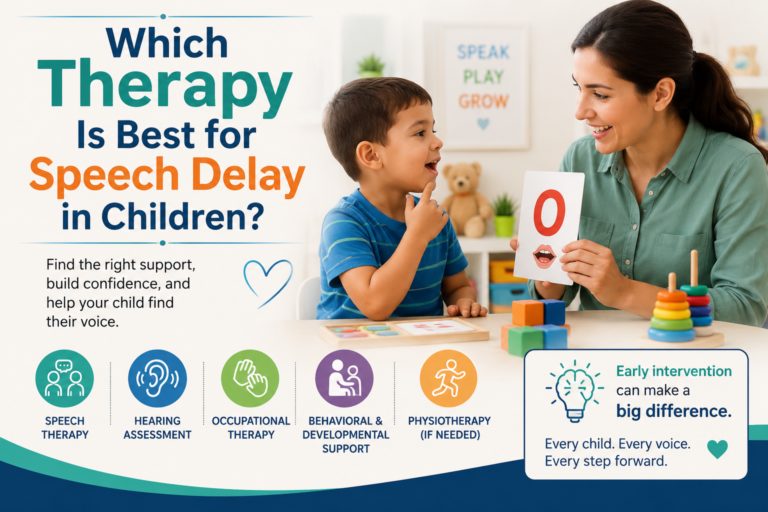
Which Therapy Is Best for Speech Delay in Children?
When a child is not speaking as expected, parents may wonder whether to wait or seek help. For many children, speech-language therapy is the central intervention, supported by hearing and developmental assessment. Understanding the cause is important because every child develops communication differently. So, which therapy is best for speech delay in children? The answer depends on the child’s specific needs, abilities, and underlying reason for the delay.
Understanding Speech Delay
Speech delay means spoken words are developing more slowly than expected. Some children understand language but struggle to express themselves or follow language. Speech sounds may also be unclear even when vocabulary is growing.
Possible contributors include hearing loss, developmental language disorder, autism, oral-motor difficulties, limited opportunities for interaction, or broader developmental differences. Because causes vary, an accurate assessment should come before choosing a treatment plan.
A qualified speech-language therapist evaluates communication skills, including vocabulary, sentence formation, comprehension, social communication, and speech clarity. Hearing should be checked because difficulties can affect speech and language learning. These steps support evidence-based, individualized care.
Which Therapy Is Best for Speech Delay in Children?
For many children, speech and language therapy is the appropriate starting point. This directly addresses the question: Which therapy is best for speech delay in children? The answer still depends on the individual child.
Sessions are tailored to age, abilities, interests, and goals. Therapy may focus on:
Building vocabulary through play and everyday routines
Encouraging gestures, sounds, words, and short phrases
Improving understanding of questions and instructions
Developing clearer speech sounds
Strengthening turn-taking and social communication
Teaching parents strategies to support communication between sessions
Some children may also use alternative or augmentative communication, such as picture systems or speech-generating devices. They provide reliable communication while speech develops.
Other Therapies a Child May Need
Speech-language therapy is not always the only support required. When parents ask, Which therapy is best for speech delay in children?, the assessment should determine whether additional support is necessary.
1. Hearing support: An audiologist can assess hearing and recommend management if hearing loss is present.
2. Occupational therapy: This may help alongside sensory, attention, or fine-motor challenges.
3. Developmental or behavioral support: Children with broader developmental differences may benefit from structured communication and social interventions.
4. Physiotherapy: With motor-development concerns, physiotherapy may be part of coordinated care.
The goal is targeted support, not simply more therapies.
A Simple Step-by-Step Approach
If you are concerned about a child’s speech, ask which therapy is best for speech delay in children and consider these practical steps:
Notice the pattern. Track words, gestures, understanding, sounds, and changes over time.
Arrange a hearing check. Hearing is an important foundation for language learning.
Book a speech-language assessment. Ask what skills are delayed and what goals are recommended.
Follow the home program. Repeated activities during meals, books, and play can reinforce therapy.
Review progress regularly. Goals should change as the child develops.
One family described their experience as “waiting for the words to arrive.” Their preschooler used gestures but rarely combined words. After assessment, the therapist introduced simple choices, play-based language routines, and parent coaching. Over several months, the child began using more words and short phrases. The lesson was consistent, individualized practice guided by assessment.
What Parents Should Look For in a Therapy Program
Parents should choose qualified professionals who explain findings, set measurable goals, involve the family, and show how progress will be monitored. This is central when deciding which therapy is best for speech delay in children.
A trustworthy clinic should also avoid promising instant results. This matters when considering which therapy is best for speech delay in children. Development varies widely. Progress can be gradual, and plans may change as skills emerge.
At Dhwani Clinic, families can seek individualized guidance focused on assessment, practical goals, and meaningful communication in everyday life.
FAQs-
1. What is the best therapy for speech delay in children?
Speech-language therapy is usually the main intervention, but the best plan depends on the child’s cause, age, hearing, developmental profile, and communication needs.
2. When should a child start speech therapy?
Do not rely only on “wait and see” if you have concerns. An assessment can clarify whether support is needed and what type would be appropriate.
3. Can speech delay improve without therapy?
Some children catch up naturally, but others benefit greatly from early intervention. Professional assessment helps determine whether monitoring or active therapy is more suitable.
4. Does screen time cause speech delay?
High or passive screen exposure can reduce opportunities for real-world interaction, but speech delay has many possible causes. Interactive conversation, reading, play, and responsive communication are valuable.
5. How can parents help speech development at home?
Talk during routines, read together, offer choices, expand words, pause for responses, imitate sounds, and celebrate attempts. Dhwani Clinic can help families understand which strategies fit their child.
Final Thoughts
So, which therapy is best for speech delay in children? In many cases, individualized speech-language therapy is the best starting point, supported by hearing and developmental assessment when appropriate. Early, consistent, family-centered support can help children communicate confidently and participate more fully at home, school, and in the community.
If you are concerned about your child’s communication, Dhwani Clinic can help you take the next step with professional assessment and a personalized plan.