
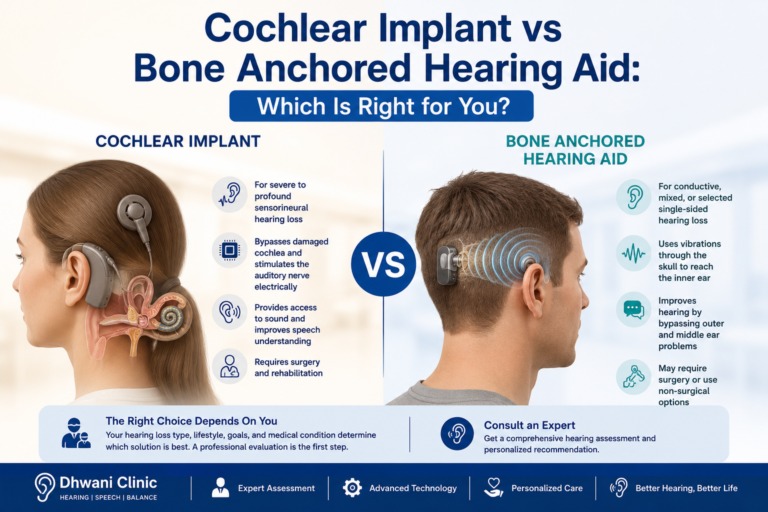
Cochlear Implant vs Bone Anchored Hearing Aid: Which Is Right for You?
Two advanced options often discussed are cochlear implants and bone anchored hearing aids. Understanding cochlear implant vs bone anchored hearing aid differences can help you ask better questions and make an informed decision. Both improve access to sound, but they work differently.
Cochlear Implant vs Bone Anchored Hearing Aid: How Do They Work?
A cochlear implant is an electronic medical device generally considered for people with severe to profound sensorineural hearing loss who receive limited benefit from conventional hearing aids. It bypasses damaged cochlear structures and stimulates the auditory nerve through electrical signals.
A bone anchored hearing aid, also called a bone conduction hearing system, uses vibrations to deliver sound through the skull to a functioning inner ear. It can be useful for conductive or mixed hearing loss. Some systems use an implanted component, while others use non-surgical attachment methods.
Simply put, a cochlear implant works around damaged cochlear function, while a bone anchored device works around problems in the outer or middle ear.
Cochlear Implant vs Bone Anchored Hearing Aid: Key Differences
| Feature | Cochlear Implant | Bone Anchored Hearing Aid |
|---|---|---|
| Main purpose | Bypasses damaged cochlear structures | Bypasses outer/middle ear problems |
| Common use | Severe-to-profound sensorineural loss | Conductive, mixed, or selected single-sided loss |
| Sound pathway | Electrical stimulation | Bone conduction |
| Surgery | Usually required | Depends on system |
| Rehabilitation | Listening practice often needed | Adaptation may be needed |
When comparing cochlear implant vs bone anchored hearing aid, ask these practical questions:
What type of hearing loss do I have?
How much benefit do my current hearing aids provide?
Is my inner ear functioning well?
Are there anatomical or medical issues affecting my ears?
What outcome fits my communication goals?
A Real-World Perspective: Why Assessment Matters
Imagine a child with a long-standing middle-ear condition. Conventional hearing aids may not provide an efficient pathway for sound because the outer or middle ear is not functioning normally. A bone anchored hearing aid may offer another route to the inner ear.
Now consider an adult with severe cochlear damage. Even a powerful hearing aid may provide limited speech clarity. A cochlear implant may be considered because it can stimulate the auditory nerve more directly.
This example shows why cochlear implant vs bone anchored hearing aid is not a “better versus worse” decision. The appropriate technology depends on the person’s hearing pathway, diagnosis, and goals.
At Dhwani Clinic, a detailed assessment can help patients discuss suitable options with professionals. Good hearing care combines evidence-based evaluation, clear counseling, and realistic expectations.
Benefits, Limitations, and What to Expect
Cochlear implants can provide meaningful access to speech and environmental sounds for appropriately selected candidates. Surgery, programming, follow-up care, and rehabilitation are important parts of treatment. People with limited previous access to sound may need more time to develop listening skills.
Bone anchored hearing aids can help when sound cannot efficiently pass through the outer or middle ear. Treatment may involve surgery or an external attachment. Benefits can include improved audibility and speech access, but results depend on the condition of the inner ear and auditory nerve.
For cochlear implant vs bone anchored hearing aid decisions, discuss:
Your exact type and degree of hearing loss.
Whether conventional hearing aids still provide useful benefit.
The recommended procedure and recovery requirements.
Device maintenance and follow-up.
The hearing outcome you can realistically expect.
A professional evaluation should guide the decision.
Cochlear Implant vs Bone Anchored Hearing Aid: Making the Decision
A cochlear implant may suit someone whose severe sensorineural hearing loss limits hearing-aid benefit. A bone anchored hearing aid may suit someone with conductive or mixed loss, or selected single-sided hearing loss where the inner ear can receive bone-conducted sound.
If you are comparing cochlear implant vs bone anchored hearing aid options, begin with a comprehensive hearing assessment. At Dhwani Clinic, patients can receive guidance based on test results rather than a one-size-fits-all recommendation.
Frequently Asked Questions
1. Is a cochlear implant better than a bone anchored hearing aid?
Not necessarily. They address different hearing problems. Cochlear implants are generally considered for significant sensorineural loss, while bone anchored technology is commonly used for conductive or mixed loss and selected single-sided cases.
2. Can a bone anchored hearing aid treat profound hearing loss?
It depends on the functioning inner ear. Bone conduction requires usable cochlear and auditory nerve function, so another solution may be more appropriate for profound sensorineural loss.
3. Does a cochlear implant restore normal hearing?
No. It provides a different way to access sound rather than recreating natural hearing. Outcomes vary, and rehabilitation can be important.
4. Is surgery always required for a bone anchored hearing aid?
No. Some systems use non-surgical attachment methods, while others involve an implanted component. Your specialist can explain the suitable approach.
5. How do I choose between the two?
Start with a detailed hearing and medical assessment. Your specialist can compare hearing thresholds, speech understanding, anatomy, medical history, and lifestyle goals before recommending an option.
The choice is personal and clinical. Hearing goals should guide the final choice. If you are still unsure about cochlear implant vs bone anchored hearing aid options, schedule a professional hearing assessment. Dhwani Clinic can help you understand your diagnosis, discuss suitable technologies, and take the next step toward clearer communication.