
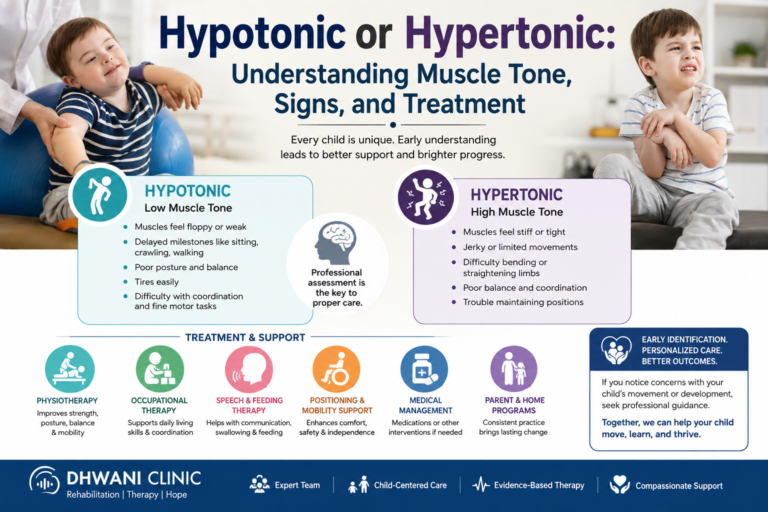
Hypotonic or Hypertonic: Understanding Muscle Tone, Signs, and Treatment
A child who feels unusually floppy, stiff, or awkward while moving may have differences in muscle tone. Parents often wonder whether the problem is hypotonic or hypertonic when sitting, standing, walking, or reaching seems delayed. Understanding the difference between Hypotonic or Hypertonic patterns can guide support.
Muscle tone is tension in muscles at rest. It supports posture, joint stability, and movement. When tone is unusually low or high, coordination and daily activities can be affected. Muscle tone is different from muscle strength.
What Does Hypotonic or Hypertonic Mean?
Hypotonia means reduced muscle tone. A child may feel floppy when held and have difficulty maintaining posture, head control, sitting, or balance.
Hypertonia means increased muscle tone. Muscles may feel tight or resist movement, affecting walking, reaching, posture, or coordination. Stiff movements, crossed legs, or tight arms may occur.
When parents ask whether a child is hypotonic or hypertonic, the answer cannot come from one symptom. A qualified clinician should assess movement, reflexes, posture, strength, development, and function.
Hypotonic or Hypertonic: Key Signs to Watch
Knowing whether a child is Hypotonic or Hypertonic can help families describe concerns clearly.
Possible signs of hypotonia:
Head control develops later than expected.
The child appears floppy.
Sitting or standing needs extra support.
Movements may look slow or poorly controlled.
The child tires.
Grasping or other fine-motor tasks may be difficult.
Possible signs of hypertonia:
Muscles feel unusually tight or stiff.
Movement appears jerky or restricted.
Bending or straightening a limb is difficult.
Legs may cross while standing or walking.
Positions are difficult to maintain.
Balance and coordination may be affected.
These signs do not establish a diagnosis. Cerebral palsy, neurological conditions, genetic disorders, and other factors can influence tone.
How Is Muscle Tone Evaluated?
An evaluation helps distinguish whether a child is Hypotonic or Hypertonic and how tone affects function. Assessing whether a child is hypotonic or hypertonic requires several observations rather than one test.
Developmental history: Milestones and changes are reviewed.
Physical examination: Posture, tone, reflexes, joints, and symmetry are observed.
Functional assessment: Sitting, standing, walking, and reaching may be assessed.
Neurological evaluation: Further testing or referral may be recommended.
Therapy assessment: Therapists assess effects on daily participation.
A parent once described her toddler as “weak” because he struggled to sit. Assessment showed that low tone and poor postural control were affecting stability. This helped the family understand why targeted therapy could be more useful than simply encouraging exercise.
At Dhwani Clinic, assessment and therapy planning should reflect the child’s abilities, developmental stage, and family goals. Early guidance can determine whether further evaluation is needed.
Hypotonic or Hypertonic: Treatment and Support
Support for Hypotonic or Hypertonic patterns is tailored to the child, not just the label. Treatment depends on the cause, severity, age, and functional impact. Treatment may include:
Physiotherapy: Exercises can improve strength, balance, posture, mobility, and motor control.
Occupational therapy: Activities can support hand skills, coordination, self-care, and participation.
Speech and feeding therapy: Some children with altered tone may need help with communication, chewing, or swallowing.
Positioning and mobility support: Appropriate equipment can improve safety and independence.
Medical management: In selected cases, doctors may recommend medicines or other interventions for significant stiffness or an underlying condition.
Home practice: Therapists can teach parents safe activities to reinforce skills between sessions.
If you are unsure whether a child is hypotonic or hypertonic, avoid comparisons with other children. Development varies, but persistent concerns deserve attention. Record milestones, unusual movements, fatigue, falls, or difficult activities and share them with a professional.
Dhwani Clinic focuses on child-centered rehabilitation, connecting goals to meaningful activities. Consistency, realistic goals, caregiver involvement, and review can support progress.
When Should Parents Seek Help?
Parents should consider evaluation for persistent difficulty with head control, sitting, standing, walking, balance, coordination, or age-appropriate activities. Sudden changes, loss of acquired skills, severe stiffness, unusual weakness, swallowing difficulties, or major movement changes need prompt medical attention.
Do not panic after one unusual behavior; look at the overall pattern. Whether a child is hypotonic or hypertonic, early identification can guide appropriate support.
FAQs-
1. What is the main difference between hypotonic or hypertonic muscle tone?
Hypotonia involves lower-than-expected muscle tone, while hypertonia involves increased tone and resistance to movement.
2. Can a child have both hypotonic or hypertonic features?
Tone can vary between body parts or change with development and neurological conditions. A professional assessment is needed to understand the pattern.
3. Is hypotonia the same as muscle weakness?
No. Hypotonia describes reduced tone; weakness describes reduced force. They can occur together.
4. Can therapy improve hypotonic or hypertonic symptoms?
Therapy can improve function, mobility, strength, balance, and participation, depending on the child’s needs.
5. When should I consult a specialist about Hypotonic or Hypertonic signs?
Consult a pediatrician, neurologist, or rehabilitation professional when concerns persist, milestones are delayed, or skills are lost.
Take the Next Step
If you are concerned about your child’s movement, posture, stiffness, or delayed milestones, don’t rely on guesswork. A timely assessment can clarify whether the pattern is hypotonic or hypertonic and identify suitable next steps. Contact Dhwani Clinic to discuss your concerns and explore an individualized therapy plan.